Why Nurture Journeys Matter More Than Ever
Customers usually won’t purchase or take the desired action the first time they encounter your business. In fact, it takes seven to eight touchpoints before a customer makes a purchase or decision (Nethunt), although, more recent studies are suggsting between 8 – 20. It’s little wonder, the vast quanitity of product options, can make making a decision a complex, time consuming process.
This is where a nurture journey can enter to decrease those touchpoints, or at the very least, instill condeince that your brand or product is the best choice. A journey is a planned series of marketing messages to assist with the decision making process.
What Is a Customer Nurture Journey?
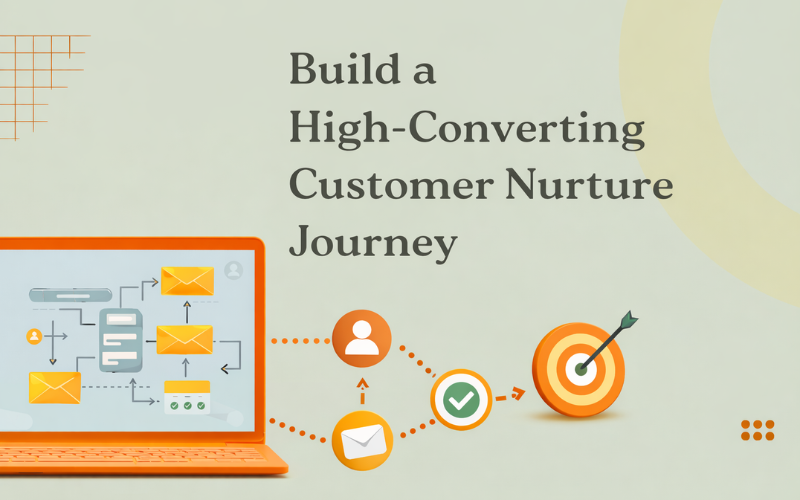
Simply put, a nurture journey is a planned series of communications designed to guide prospects toward becoming customers. It utilises an integrated mix of channels, including email, SMS, social media, retargeted ads, and sales calls, to create consistent, meaningful touchpoints over time.
Rather than relying on one-off messages, a nurture journey delivers a structured sequence of personalised communications aligned with where the prospect is in their decision-making process. These journeys are typically set up as automated programmes within a CRM or marketing automation platform, where each communication is triggered by a specific customer action or behaviour.
For example, a prospect may sign up to your newsletter, triggering an automated welcome email introducing your business and setting expectations. If the prospect opens the email and clicks through to your website, this signals engagement and moves them into the next stage of the journey. From there, future communications can be further tailored to their interests, such as sharing helpful resources, case studies, or relevant offers. This progressive approach ensures each interaction feels relevant rather than generic.
This differs significantly from traditional broadcast marketing, where the same message is sent to an entire audience regardless of their level of interest, behaviour, or readiness to buy. Broadcast marketing treats every contact equally, whereas nurture journeys adapt dynamically to each individual.
The key advantage of a nurture journey is that it builds trust over time. Most prospects are not ready to purchase immediately, and without ongoing communication, they may forget about your business or turn to a competitor when they are ready to buy. A well-designed nurture journey keeps your business visible, demonstrates your expertise, and reinforces your credibility at every stage.
It also allows small businesses to scale their communications efficiently. Once set up, automated nurture journeys work continuously in the background, ensuring every new lead receives a consistent, high-quality experience without requiring manual follow-up. This not only saves time but also improves conversion rates by ensuring no opportunities are missed.
Ultimately, nurture journeys transform passive interest into active intent. By delivering the right message, to the right person, at the right time, small businesses can build stronger relationships, shorten sales cycles, and convert more prospects into loyal customers.
How to make an impactful nurture journey
Stage 1: Awareness & Welcome (Day 0–2)
Goal: Build trust and make a strong first impression.
Recommended communications:
- Welcome email
- Brand story
- Set expectations (what they’ll receive and how often)
Key elements:
- Personalisation
- Warm tone
- Clear value proposition
Stage 2: Education & Value (Day 3–14)
Goal: Position your business as helpful and knowledgeable.
Recommended content:
- Tips and guides
- FAQs
- Case studies
- Helpful resources
Communication frequency:
- 2–4 emails spaced out
Key principle:
- Give value before asking for a sale
Stage 3: Credibility & Trust Building (Day 10–21)
Goal: Remove doubt and build confidence.
Recommended communications:
- Testimonials
- Reviews
- Before/after examples
- Social proof
- Founder story
This stage reduces perceived risk.
Stage 4: Offer & Conversion (Day 14–30)
Goal: Encourage the first purchase or enquiry.
Recommended communications:
- Introductory offer
- Limited-time incentive
- Clear call-to-action
Examples:
- Book a consultation
- Request a quote
- Make a first purchase
Stage 5: Follow-Up & Long-Term Nurture (Ongoing)
Goal: Stay top-of-mind until they’re ready.
Recommended communications:
- Monthly newsletters
- New offers
- Educational content
- Customer success stories
Most customers convert here, not earlier.
Example: Simple 7-Email Nurture Sequence Small Businesses Can Use
Email 1: Welcome & introduction
Email 2: Helpful tips related to your service
Email 3: Your story and why you started
Email 4: Case study or customer success story
Email 5: Common mistakes to avoid
Email 6: Offer or invitation
Email 7: Reminder and reassurance
Best Practices for Small Business Nurture Communications
Keep it personal
- Use names
- Write conversationally
- Avoid corporate tone
Be consistent
- Consistency builds familiarity and trust
Focus on helping, not selling
- 70–80% value, 20–30% selling
Segment when possible
Examples:
- New leads vs existing customers
- Service interest
- Engagement level
Common Mistakes Small Businesses Should Avoid
- Only email when selling something
- Sending too many emails too quickly
- Not sending any nurture communications at all
- Being overly promotional
- Not having a clear plan
Tools Small Businesses Can Use to Automate Nurture Journeys
Examples:
- Email platforms (Mailchimp, HubSpot, ActiveCampaign, Klaviyo)
- CRM systems
- SMS platforms
Explain that automation saves time and increases consistency.
How to Measure If Your Nurture Journey Is Working
Key metrics:
- Open rate
- Click rate
- Reply rate
- Conversion rate
- Enquiry rate
Explain optimisation over time.
Simple Starter Nurture Journey Any Small Business Can Launch This Week
Example:
- Day 0: Welcome email
- Day 3: Helpful tips
- Day 7: Case study
- Day 14: Offer
- Monthly: Newsletter
Emphasise simplicity over perfection.
Conclusion: Nurture Journeys Turn Interest Into Revenue
It’s important to remember that most customers aren’t ready to purchase immediately. Consistent, thoughtful communication helps build trust and credibility over time, ensuring your business remains front of mind when they are ready to make a decision. Personalised, relevant messages are far more effective than generic broadcasts, and a well-structured nurture journey plays a critical role in converting interest into paying customers.
Start simple. Your emails and communications do not need to be over-engineered or overly polished. In many cases, a genuine, conversational message will resonate far more than heavily designed templates filled with graphics and gimmicks. Authenticity builds connection, and connection builds trust.
As your nurture journey develops and prospects begin entering your workflow, automation becomes essential to maintain consistency and manage scale. Automation ensures that every lead receives timely, relevant follow-up without adding to your day-to-day workload. Fortunately, there are many excellent free and low-cost platforms available that make it easy for small businesses to get started. I’ve rounded up my top recommended tools in this blog here.
A well-designed nurture journey ensures no opportunity is wasted, allowing your business to build meaningful relationships at scale and convert more prospects into loyal, long-term customers.